SPYN™

Overview
Urban cyclists rely heavily on smartphones for directions, but glancing at a map or using voice prompts results in lost situational awareness. SPYN solves this by creating a screen-free navigation interface that works efficiently in a rider’s peripheral vision.
Year:
2025
Category:
Navigation Aid
/
Product Interaction Design
Location:
Pune, Maharashtra


The Challenge
Screens are distracting (a one-second glance adds 10–15 m of blind travel) and susceptible to glare. Audio directions mask critical road sounds ("auditory blindfold") and can be drowned out by ambient noise.
The core problem was: “How might we design a navigation system for cyclists that eliminates the need to look at or listen to a smartphone, yet delivers clear, real-time guidance?”.
The Solution
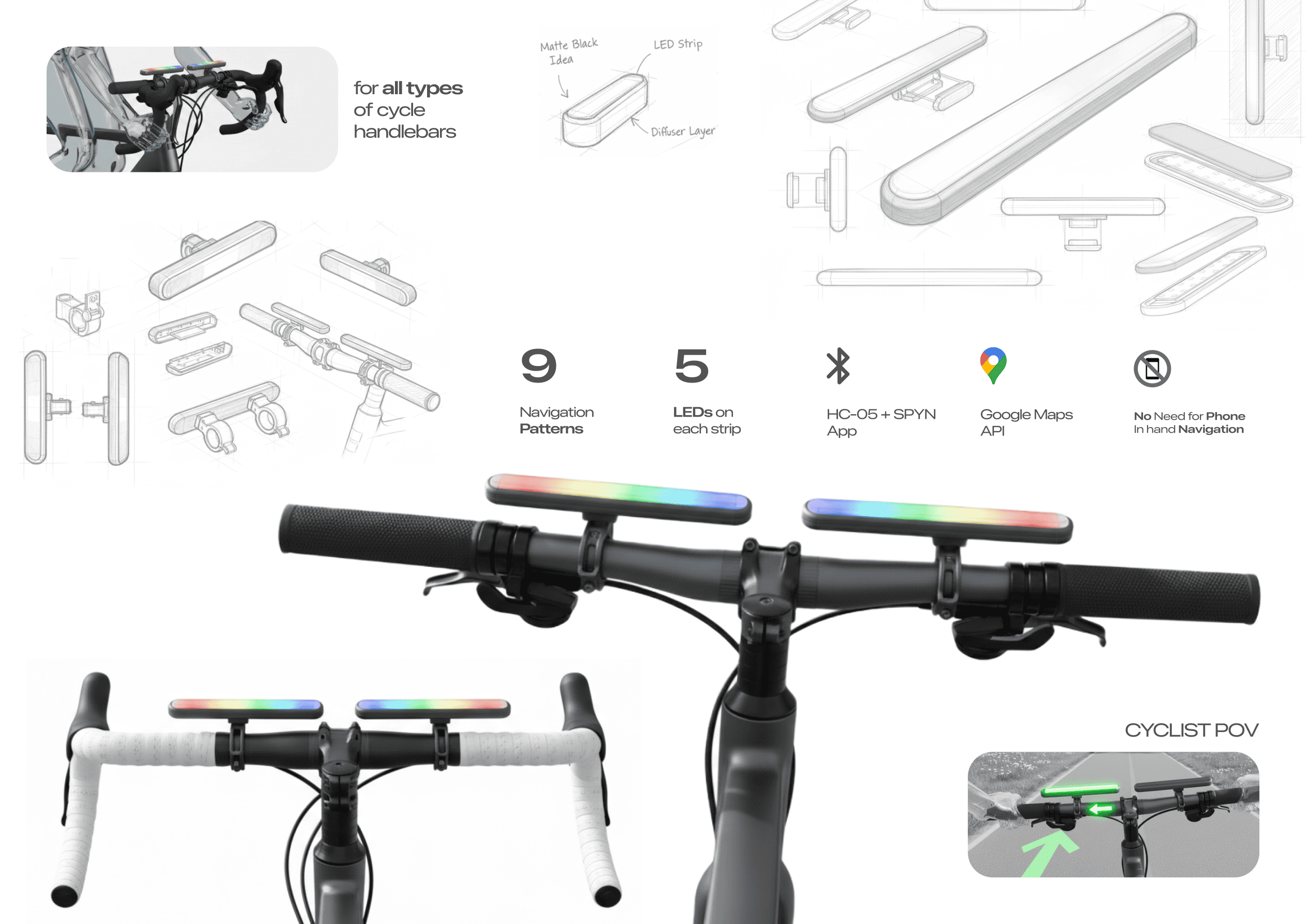
The design relies on a non-auditory, glanceable, peripheral LED interface.
The hardware uses Dual LED strips on the handlebar connected via HC-05 Bluetooth to a smartphone, with an Arduino UNO interpreting commands from the Google Maps API. The visual language includes nine distinct LED behaviours.


The Result
User testing with 6 cyclists showed that the animations are readable in daylight and at speed, and riders had no need to glance at their phone. The final prototype demonstrates how interaction design combined with embedded hardware can solve real mobility problems, providing safer navigation for urban cyclists.


